

Welcome to our FAQ's page. Expert advice, dependable support.
“Can I cut a load cell cable?” “Does a silo need to be empty during calibration?” “Can I use load cells with different capacities on the same system?”
These are just some of the questions answered in the FAQ section below, helping customers quickly find practical guidance for their weighing systems and applications.
With more than 35 years of industry experience, Applied Weighing understands the real-world challenges of industrial weighing and provides expert advice, best practice guidance and dependable support for both new and existing systems.
Frequently asked questions.
Should a silo or vessel be empty for calibration?
For a true zero calibration, it is necessary for the silo or vessel to be empty. However, a comprehensive health check, service, and calibration can be performed with material in the silo or vessel using the original zero calibration values. During this process, we meticulously cross-check each load cell signal and balance against previously recorded values to identify any issues such as drifting or shock loading.
Where are your engineers located, what is the response time, and what are the call-out costs?
Our engineers are strategically positioned across the UK to ensure prompt responses when needed. Customers with a service agreement benefit from preferential call-out rates and response times. For more information, please contact ServiceDesk@aw.co.uk
Can load cell cables be cut to tidy the installation?
Load cell cables can be cut to tidy the installation. However, it is advisable to ensure that each load cell in the system has cables of similar length. This helps maintain uniform load cell sensitivities and prevents potential cornering issues.
What are the Applied Weighing load cell cable colour codes?
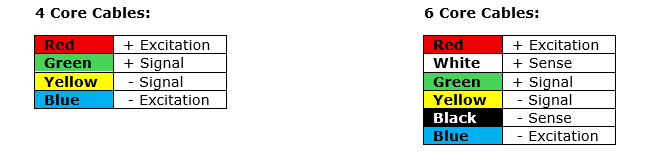
Is it okay to use different load cell capacities in the same weighing system?
No. Each load cell in a weighing system should have the same capacity. Using load cells of different capacities will result in varied outputs among the load cells, causing weighing errors.
How often should the system be checked and calibrated?
The calibration frequency will depend on your system and application; also, on your ISO requirements, if any. As a standard the calibration is carried out once a year, with more frequent checks on systems and more often recalibration if necessary.
Ask a question.
Complete the form and a member of our team will be in touch to help with any questions you have and discuss a servicing and calibration solution that best suits your requirements.
With a 100% satisfaction rating from customers on our service agreements, you can be confident you’re choosing a partner committed to accuracy, compliance and long-term peace of mind.