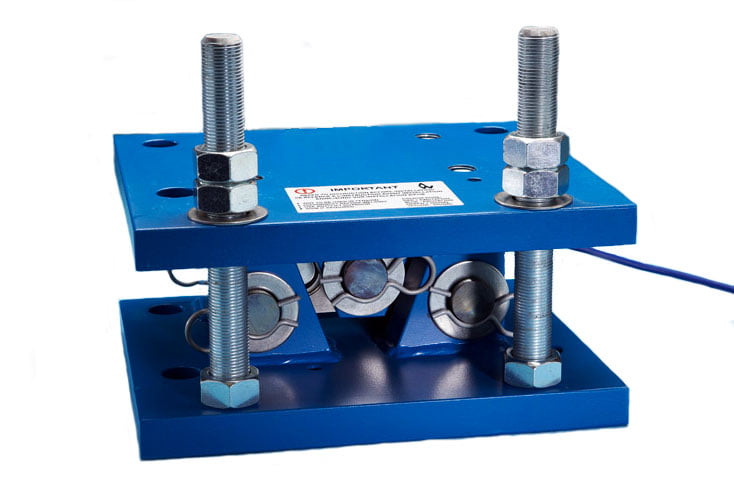
Safemount® with additional lift-off 3,500kg – 40,000kg


The Safemount® range of loading assemblies with integral lift-off protection are designed for weighing in harsh industrial applications. Uses include silos,  hoppers, vessel and tank weighing.
The loading assembly incorporates a fully welded stainless steel load cell to prevent the ingress of dust or moisture to give accurate, repeatable weighing results.

Capacities from 3,500kg to 40,000kg with ATEX option available for hazardous areas.
Features

  • Stainless steel load cell construction
  • Matched load cell output
  • BS EN 1090-2:2018 Execution Class 2
  • Inbuilt strength 150% maximum overload
  • 5 year limited warranty
  • Manufactured in the UK

Capacities

3,500kg, 5,000kg, 10,000kg, 15,000kg, 20,000kg, 30,000kg and 40,000kg

Options/Accessories

  • Plastic coated mild steel loading assembly & Stainless load cell (5,000kg to 30,000kg)
  • Plastic coated mild steel loading assembly & Stainless load cell (40,000)
  • Std base – Loadcell & plastic coated MS assembly (40t)
  • ATEX for Zone 1/21 & Zone 2/22 applications
  • ATEX Category 1 II 1GD – see certificate
  • ATEX Category 1 II 3GD – see certificate
Manuals &
Documentation
To order, or find out more about this product, fill in the form here or call 0118 946 1900
File Version Size Download
Other Files
Installation Guide n/a 987 KB Download
Levelling Guide n/a 630 KB Download
Welding Guide n/a 598 KB Download
Although Applied Weighing International Ltd routinely screens for viruses, addressees should check the attachments for any viruses on the download. Applied Weighing International Ltd makes no representation or warranty as to the absence of viruses in any attachments.

Frequently Asked Questions

For a true zero calibration, it is necessary for the silo or vessel to be empty. However, a comprehensive health check, service, and calibration can be performed with material in the silo or vessel using the original zero calibration values. During this process, we meticulously cross-check each load cell signal and balance against previously recorded values to identify any issues such as drifting or shock loading.

Our engineers are strategically positioned across the UK to ensure prompt responses when needed. Customers with a service agreement benefit from preferential call-out rates and response times. For more information, please contact ServiceDesk@aw.co.uk

Load cell cables can be cut to tidy the installation. However, it is advisable to ensure that each load cell in the system has cables of similar length. This helps maintain uniform load cell sensitivities and prevents potential cornering issues.

No. Each load cell in a weighing system should have the same capacity. Using load cells of different capacities will result in varied outputs among the load cells, causing weighing errors.

The calibration frequency will depend on your system and application; also, on your ISO requirements, if any. As a standard the calibration is carried out once a year, with more frequent checks on systems and more often recalibration if necessary.