
It’s a question we get asked regularly.
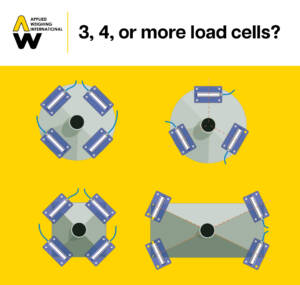
3 load cells are often ideal for wide, round silos, tanks, and hoppers. Like a three-legged stool, they naturally find their balance, making installation and load sharing simpler.
4 load cells are typically used for large or narrow round silos, platform scales, rectangular vessels, and applications where additional stability is required, particularly where mixing, wind loading, or movement could affect the structure. However, a 4-cell system requires careful levelling and load equalisation, making installation accuracy more critical.
Sometimes even more load cells are required. Large silos, weighbridges, tanks, process vessels, and heavy-duty industrial applications may use 6, 8, 10, or more load cells to safely support the load while maintaining weighing performance.
The right solution is about choosing the configuration that best suits the application, structure, operating environment, and accuracy requirements.
At Applied Weighing, we’re more than a weighing systems supplier. We’re a weighing solutions company, combining quality products with project expertise, application knowledge, a dedicated technical team, and nationwide field service engineers to deliver successful outcomes for our customers.
Three, four, or more? There’s no one-size-fits-all answer. Every weighing challenge is different, and the best solution is always the one that fits the application. That’s where our expertise comes in.
Not sure how many load cells your application really needs? Get in touch with our team for expert advice.